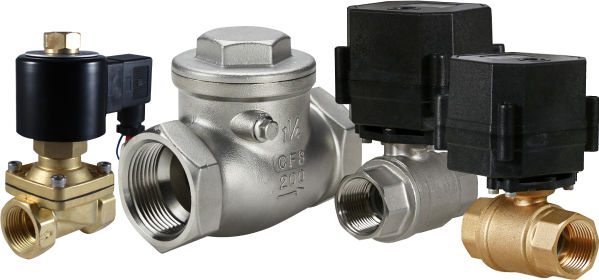
Reliable Flow Control for Food & Process Applications
Consistent, clean, and dependable flow control is essential to food and beverage operations – from ingredient
transfer and batching to CIP chemical delivery and utility lines.
Atlantic Valves provides durable stainless-steel valve solutions suited for fluid handling, mixing, dosing, washdown, and non-aseptic food processing environments. Our goal: simplify valve selection so you can maintain uptime, meet standards, and keep products flowing.
Where Our Valves Fit in Food & Beverage
Valves play a role across nearly every stage of processing:
- Ingredient Transfer – Water, syrups, juices, non-dairy liquids, and general process fluids.
- Mixing & Dosing Lines – Accurate flow control for batching, blending, and general process fluids.
- CIP & Chemical Delivery – Compatible with NaOH (Caustic) and mild acid detergents at ambient temperatures.
- Cooling & Utilities – Valves for air, water, and washdown systems.
- Packaging Equipment Utilities – High cycle valves for air, water, washdown, and pneumatic equipment.
Common Challenges in Food & Beverage (and How We Help)
|
Valve Categories for Food & Beverage
Atlantic Valves provides the most common valve types used in Food & Beverage facilities:
|
How to Choose the Right Valve
When specifying valves for food & beverage service, focus on three essentials:
- Media & Sanitation – Choose stainless steel and FDA-approved seals for any product-contact service.
- Cycle Life & Cleaning – Select valves rated for high-cycle use and resistance to hot water/steam.
- Controls & Fail-Safe Modes – Confirm available voltage (24 VDC, 120 VAC) and use normally closed valves for safety-critical lines.
Pro Tip: Standardizing on stainless steel valve bodies with EPDM or PTFE seals simplifies inventory and ensures compatibility across most F&B applications.
Why Atlantic Valves
- Sanitary Options – Stainless steel and FDA-compatible seal materials available.
- Fast Shipping – Reliable fulfillment keeps cooling and environmental systems running
- Practical Expertise – Guidance for selecting valves that balance hygiene, durability, and efficiency.
- Expert Support – Application guidance, nozzle matching, spec sheets and CAD resources.
- Proven Durability – Assembled and tested for long life in field conditions.
- Simplified Maintenance – Consistent models for easy replacement and stocking.
Supporting Food & Beverage Facilities
Every food and beverage operation has unique processes, but all share the need for clean, safe, and reliable flow control. Atlantic Valves delivers valve options that support both production and sanitation — keeping plants efficient and compliant.
Ready to Keep Your Process Clean & Productive? Contact Us Now.
Chemical Compatibility Disclaimer
Atlantic Valves has compiled this information to serve as a convenient reference for distributors and end users. It is not a substitute for proper testing, engineering review, and application-specific validation. Chemical compatibility can be affected by factors including—but not limited to—temperature, concentration, pressure, flow rate, exposure time, and combinations or mixtures of chemicals.
Atlantic Valves does not warrant, either express or implied, that the information is accurate, complete, current, or suitable for any particular application, nor that any material will perform as expected in a given system. Selection and use of products remain the sole responsibility of the installer and/or system designer, who must verify compatibility and fitness for purpose.
This content is provided for general informational purposes and does not constitute engineering or legal advice.