 Plastic Solenoid Valves provide 2-way on-off control for water, inert liquids, and other compatible low-viscosity media where corrosion resistance, lighter weight, and non- metallic body construction are preferred. This valve family includes compact plastic valves for smaller tubing and water treatment systems, while it also includes larger semi-direct acting plastic valves for utility water and general fluid handling applications.
Available configurations include direct-acting and semi-direct acting designs, normally closed and normally open options depending on series, female NPT and quick-connect connections, and sizes from 1/8 inch to 2 inches. As a result, these valves fit low-pressure systems where body material, seal material, and dimensional fit must match the application.
Available Configurations
|
|
|
|
|
|
|
|
|
|
Technical Specifications
Plastic Solenoid Valves in this family are used where corrosion resistance, compact construction, or non-metallic wetted bodies are needed for water and compatible fluid service. However, exact values vary by series, size, valve action, and coil selection, so buyers should confirm final selection against the applicable spec sheet.
| Specification | Plastic Solenoid Valves |
|---|---|
| Valve function | 2-way on-off control |
| Operating principle | Direct-acting or semi-direct acting, depending on the series |
| Body materials | Polypropylene plastic, POM plastic, Engineered Nylon Plastic (PA66) |
| Seal materials | EPDM, EPDM diaphragm |
| Connection type | Female NPT, quick connect |
| Valve action | Normally closed and normally open, depending on the series |
| Size range | 1/8 inch to 2 inches, depending on the series |
| Water operation | 0 psi minimum on direct-acting RSC threaded models, 3 psi minimum on RSC push-in models, 0 psi minimum on PSL models |
| Operating pressure | Up to 115 psi on the RSC series, up to 100 psi AC, and 90 psi DC on the PSL series, depending on size and configuration |
| Operating temperature | 25 to 212°F on RSC threaded, 25 to 175°F on RSC push-in, 15 to 175°F on PSL series |
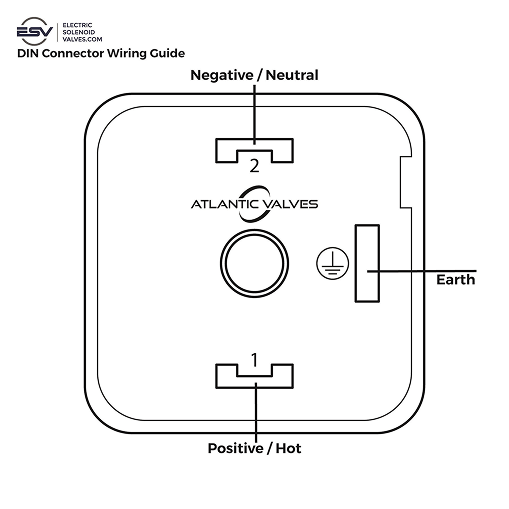
| Voltage options | 12V DC, 24V DC, 24V AC, 110V AC, 220V AC, depending on series and size |
| Duty cycle | 100% continuous duty |
| Protection class | IP54 on RSC, NEMA 4 / IP65 on PSL |
| Certifications | CE, RoHS on PSL, with FDA-related compliance listed on RSC series |
Pressure, Temperature, and Media Fit
These valves are designed for low-pressure water and compatible fluid systems where plastic construction is preferred. For example, the RSC threaded model uses a direct-acting design and can operate from 0 psi differential pressure. In contrast, the RSC push-in model uses a semi-direct acting design and requires a minimum of 3 psi differential pressure for reliable operation. The PSL series is a semi-direct acting plastic valve that is gravity feed capable and operates from 0 psi minimum pressure.
Media compatibility varies by construction. For example, the RSC series is positioned for clean water and low-viscosity fluids, while the PSL series is suited for inert liquids and gases, water, and other neutral media. Therefore, review the final seal and body selection for chemical compatibility.
Dimensions and Size Range
Dimensional fit varies by series, size, and valve action, so buyers should review the applicable dimensional data before specifying for equipment layouts, pipe clearance, or compact assemblies. Specifically, RSC plastic models cover 1/8 inch and 1/4 inch sizes, while PSL plastic models cover 1/2 inch to 2 inch sizes in normally closed and normally open configurations.
| Series | Body Material | Size Range | Notes |
|---|---|---|---|
| RSC Threaded | Polypropylene plastic | 1/8 inch to 1/4 inch | Direct-acting female NPT design |
| RSC Push-in | POM plastic | 1/4 inch | Semi-direct acting quick connect design |
| PSL Series | Engineered Nylon Plastic (PA66) | 1/2 inch to 2 inch | Semi-direct acting female NPT design, available in NC and NO |
Design and Performance
- Plastic body construction for lightweight, corrosion-resistant installations
- Direct-acting and semi-direct acting options depending on the series
- Compact small-port models for tubing and water treatment systems
- Larger port semi-direct acting models for utility water and general flow control
- Low-pressure operation, including zero differential pressure capability on selected models
- Suitable for continuous energization, 100% duty cycle
- Can be mounted vertically or horizontally
Series Options
RSC Plastic Series
The RSC Series covers compact plastic body valves used primarily for clean water and low-viscosity fluid service. The threaded model uses a direct-acting design with 0 psi minimum differential pressure, while the push-in model uses a semi-direct acting design and requires 3 psi minimum differential pressure.
In addition, this series includes polypropylene and POM body constructions, EPDM sealing materials, and female NPT or quick-connect port options.
PSL Plastic Series
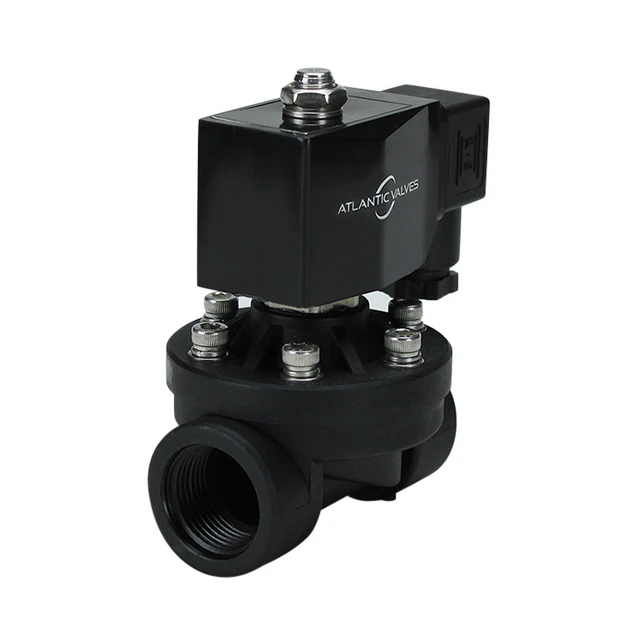
The PSL Series is a larger semi-direct acting plastic solenoid valve for inert liquids and gases in 1/2 inch to 2-inch female NPT sizes. It uses engineered nylon plastic (PA66) body construction and EPDM diaphragm sealing, while it is available in normally closed and normally open configurations. As a result, this series suits low-pressure utility water and general fluid control where larger port sizes are needed.
Typical Uses
|
|
|
|
|
|
|
|
|
|
|
|
Technical Resources
For exact dimensional, pressure, and electrical values by size and configuration, review the applicable series documentation before ordering or quoting.
- Download the RSC Plastic Valve Series spec sheet
- Download the PSL Plastic Valve Series spec sheet
- Contact Atlantic Valves for configuration support
- Request assistance confirming size, voltage, valve action, and connection type
Technical Note
These valves are not intended for use in medical life support, combustion, aviation, aerospace, automotive, or similar applications. In addition, some compact plastic valves may be unsuitable for gravity-fed systems due to a small orifice size. Review final material and seal selection for chemical compatibility.