Check valve sizing is one of the most overlooked causes of water hammer and repeated valve failure in pumping systems. Many installations meet pressure class and material requirements, yet still experience noise, slam, and premature wear because the valve was sized to match pipe diameter instead of real operating conditions.
- “That noise is just water hammer.”
- “Check valves always fail there.”
- “We’ve already replaced that valve twice.”
In many cases, these problems appear even when the valve material is correct, the pressure rating is adequate, and the installation follows the drawings. The common assumption is that the service is harsh, the system is unstable, or check valves are simply unreliable components. In reality, many of these recurring issues come back to one overlooked decision made early on: check valve sizing.
Check valves are often selected quickly, sometimes as an afterthought, based on pipe size and pressure class. Once installed, they’re expected to quietly do their job for years. When problems appear, the valve is blamed, replaced, and the cycle repeats.
What is often missed is that a check valve operates in a dynamic hydraulic system. Flow velocity, pump behavior, system inertia, and closing speed all affect how the valve responds during normal operation and shutdown. A valve can meet its pressure rating and material specification and still perform poorly if it is not sized for the actual flow conditions.
This guide takes a more practical look at how proper check valve sizing reduces water hammer and nuisance failures, why common sizing habits fail in real systems, and what you can do differently to improve reliability without overcomplicating the design process.
Understanding Water Hammer in Check Valve Sizing Applications
Water hammer happens when flowing fluid is forced to stop or change direction rapidly. This results in a pressure surge, or high-pressure shockwave that propagates through a piping system. This shockwave is also commonly referred to as a hydraulic shock or hydraulic surge, and may be characterized by a marked banging or knocking sound on the pipes immediately after shutoff.
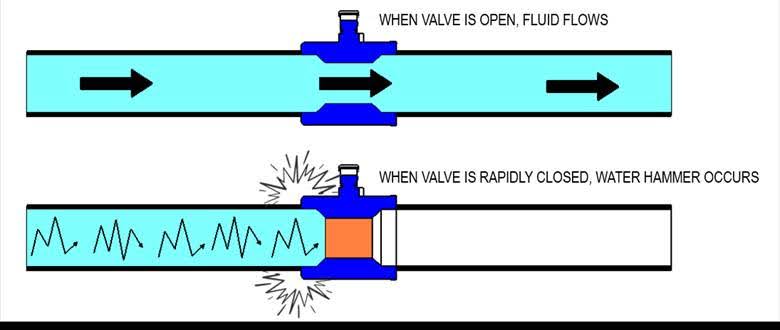
Check valves are directly involved in this process because they control how and when flow is stopped during reversal. If the valve disc closes before reverse flow accelerates, closure is smooth. If it closes after reverse velocity builds up, the disc slams into the seat.
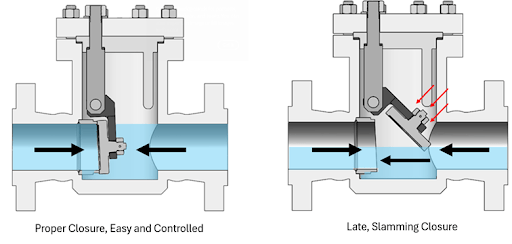
Figure 1
Figure 1 illustrates the difference between early, controlled closure and late, high impact-closure caused by reverse flow.
Valve sizing has a major influence on which of these behaviors occur in real systems.
Oversized check valves are especially prone to this problem. Because the disc is larger and heavier, it reacts more slowly to changing flow conditions. Instead of following the flow smoothly, it lags behind.
By the time the disc reaches the seat, reverse flow is often already well established. Closure then happens at high velocity, resulting in strong impact forces and large pressure fluctuations.
In practical terms, proper sizing allows the disc to begin closing while forward flow is still decelerating. Poor sizing forces the valve to react only after reverse flow has already developed, which makes slamming almost unavoidable.
Nuisance Failures: The Ones That Never Quite Go Away
Not every problem announces itself with a loud bang. The most frustrating failures are often subtle and persistent.
Nuisance valve failures show up as:
- Continuous rattling/clicking sounds
- Vibrations on piping and support
- Gradual loss of tight shutoff
- Damaged or weakened springs
- Short service life with no obvious cause
These issues rarely trigger emergency shutdowns, but they drain maintenance resources over time. Technicians replace valves during planned outages, only for the same symptoms to return months later.
The root cause is usually the same: the valve never operates in a fully stable position.
When a check valve is oversized, normal operating flow may only partially open the disc. Instead of staying fully open, the disc floats somewhere in between, constantly reacting to small changes in flow. Every oscillation creates wear. Over thousands of cycles, internal components fatigue and fail.
This is not a defect. It’s the predictable result of incorrect check valve sizing.
Why Check Valve Sizing Mistakes Keep Happening
If the consequences of poor check valve sizing are so clear, it is fair to ask why the same mistakes continue to appear in system after system.
In most cases, the problem is not a lack of technical knowledge. It is the result of common habits and shortcuts that develop during design and equipment selection.
- Matching Valve Size to Pipe Size
This is the most common habit and the hardest to break. Pipe size is easy to identify, and selecting a valve of the same size feels safe. Unfortunately, pipe sizing is based on velocity limits and pressure loss, not valve dynamics.
A check valve doesn’t care what size the pipe is—it cares about how much energy is available to move its disc.
- Oversizing to “Be Conservative”
Oversizing often feels like a conservative choice. Lower pressure drop sounds good, and a larger valve seems less restrictive. In reality, oversizing removes the very flow energy the valve needs to operate correctly.
- Assuming the System Will Always Run at Design Flow
Many systems rarely see their design flow. Pumps operate at partial load, processes cycle, and demand fluctuates. A valve sized only for peak conditions may misbehave for most of its service life.
- Relying Only on Pressure Rating
Pressure class ensures the valve won’t fail structurally, but it says nothing about how it will behave during transient events. Perfect ratings don’t prevent a valve from causing severe water hammer.
These shortcuts save time during design, but they often create long-term reliability problems.
What Proper Check Valve Sizing Really Means
Good check valve sizing isn’t complicated, but it does require a shift in thinking. Instead of asking, “What size valve fits the pipe?”, the better question is, “How will this valve behave in real operating conditions?”
Normal and Minimum Flow Matter More Than Maximum Flow
Design flow is important, but minimum and normal operating flows determine how the valve behaves most of the time. The valve must receive enough velocity to open fully and remain stable.
Velocity Drives Stability
Velocity through the valve determines disc lift and responsiveness. Too little velocity leads to flutter and chatter. Too much velocity increases wear. The goal is a stable operating window.
Cv Should Be Used Thoughtfully
Many engineers treat Cv as a marketing number, but it becomes a useful sizing tool when they use it correctly. A valve with extremely high Cv relative to system flow may look efficient, but it may never operate properly.
Orientation Is Not a Detail
Horizontal and vertical installations behave very differently. Gravity can assist closure in some cases and worsen slam in others. You need to consider this during sizing, not after installation.
Transients Are the Real Test
The most demanding moment in a check valve’s life is often a pump trip. If the valve closes too late during this event, no amount of steady-state performance will compensate.
Valve Type Selection Still Matters
Even with correct sizing, valve design plays a role in how well the system performs.
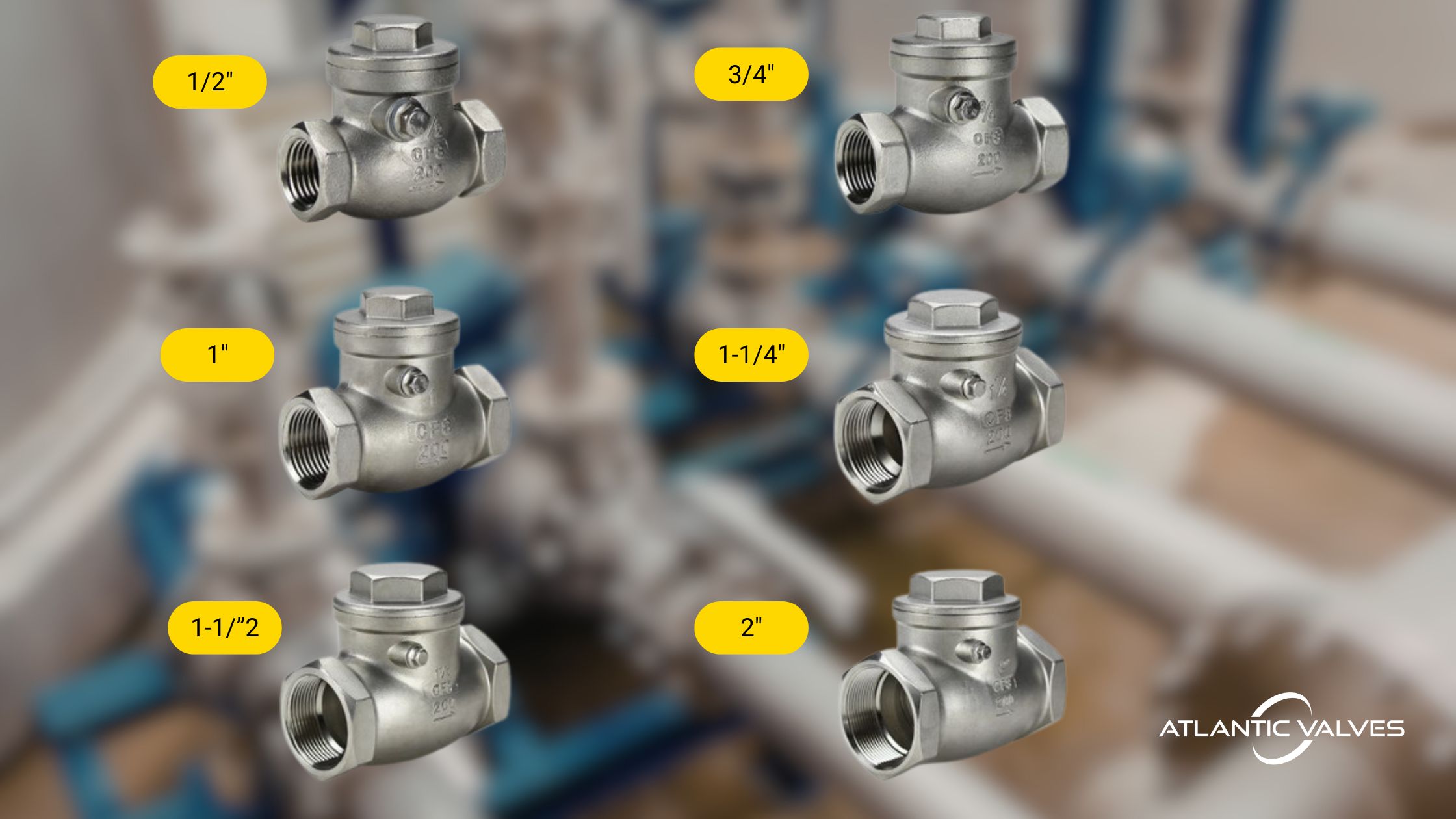
- Swing check valves have long disc travel and are sensitive to oversizing. They can work well in steady systems but often struggle on pump discharges.
- Dual-plate check valves reduce disc mass and close faster, but still require sufficient velocity for stable operation.
- Spring-assisted check valves improve closure timing and low-flow performance.
- Silent and non-slam check valves, when properly sized, are highly effective at reducing water hammer.
- The key point is that no valve type can compensate for poor sizing. Correct sizing lets the valve design perform as intended.
Final Thoughts: Failures Aren’t Inevitable
People often treat water hammer and nuisance check valve failures as unavoidable realities of pumping systems. They shouldn’t be.
In many cases, the valve isn’t failing because it’s weak or poorly made. It’s failing because it was never allowed to operate in a stable range. Proper check valve sizing, combined with thoughtful selection, transforms a troublesome component into a quiet, reliable one.
A well-sized check valve rarely gets attention. It doesn’t make noise, it doesn’t vibrate, and it doesn’t end up on the maintenance schedule every year. That invisibility is a sign that it’s doing its job.
The takeaway is simple: Size check valves for behavior, not convenience—and the failures stop following you from system to system.
What worked years ago may no longer be appropriate today. Revisiting check valve sizing when you change the system often prevents failures that people would otherwise blame on “bad valves.”
For Distributors and OEM Partners
If you’re supporting end users who struggle with repeated check valve failures, sizing guidance matters as much as availability. Atlantic Valves works directly with distributors and OEMs to help match check valve type and sizing to real operating conditions, not just pipe diameter.
We stock dual plate, silent, and non-slam check valves ready to ship, and we support your team with technical selection input when needed.
Interested in partnering with Atlantic Valves?
Apply to become a distributor and gain access to stock availability, technical support, and reliable lead times designed to keep your customers operating without repeat failures.