The performance of valves in different fluid applications depends on their design and internal construction. Flow coefficient value (Cv) and orifice size are design considerations one must verify before subjecting a valve to a specific fluid application. Valve distributors should be aware of the differences and the relationship between Cv and orifice sizes.
Understanding how these valve parameters relate to fluid flow allows you, the distributor, to effectively recommend Atlantic Valves products to customers.
What is Cv Value of a Valve?
Flow coefficient (Cv) is a standard industry measurement determining how much fluid can pass through a valve under specific conditions. It is a critical measurement that aids in sizing valves for different applications. Broadly, the flow coefficient can be defined as the amount of water in gallons per minute (GPM) that can pass through a valve opening at a pressure drop of 1 pound per square inch(PSI).
While Cv is defined using water, it’s widely used to estimate air flow (SCFM) in pneumatic valves. For compressible media like air, Cv is a comparative sizing tool, not a direct flow rate.
To explain Cv to a customer seeking our products, consider a valve with a Cv value of 3.5. It means that the valve will allow fluids to flow through it at a rate of 3.5 gallons per minute whenever the pressure drop across the valve is 1 psi.
Mathematically, the flow coefficient is represented as:
Cv=Q√(SG/ΔP)
- Cv: Flow coefficient (it is a dimensionless measurement)
- Q: flow rate in gallons per minute (GPM)
- SG: Specific gravity of fluids
- ΔP: Pressure drop across the valve (pound-force per square inch)
Cv directly affects how much fluid can flow through a valve under specific flow conditions and pressure. That is:
- A higher Cv value translates to higher flow rates past the valve. The flow path is wider, and fluids pass through the valve easily.
- A smaller Cv value means the valve has higher resistance to fluid flow, therefore leading to low flow rates past the valve.
Scenario
A customer is looking for a ball valve for outdoor water distribution. The system requires a flow rate of 10 GPM and the system pressure drop is limited to 4 psi. How will you know which valve to recommend?
- Use the formula for the Cv value and input the flow variables.
- Cv=10*14 (flow rate is 10 GPM, specific gravity for water is 1 and pressure drop is 4psi
- By calculation, Cv=5
Therefore, you will choose a ball valve from Atlantic Valves whose Cv is 5 or closer. Choosing a valve with a lower Cv value means a lower flow rate and thus they cannot achieve the desired fluid flow rates.
Effects of Wrong Valve Sizing Based on the Cv Value
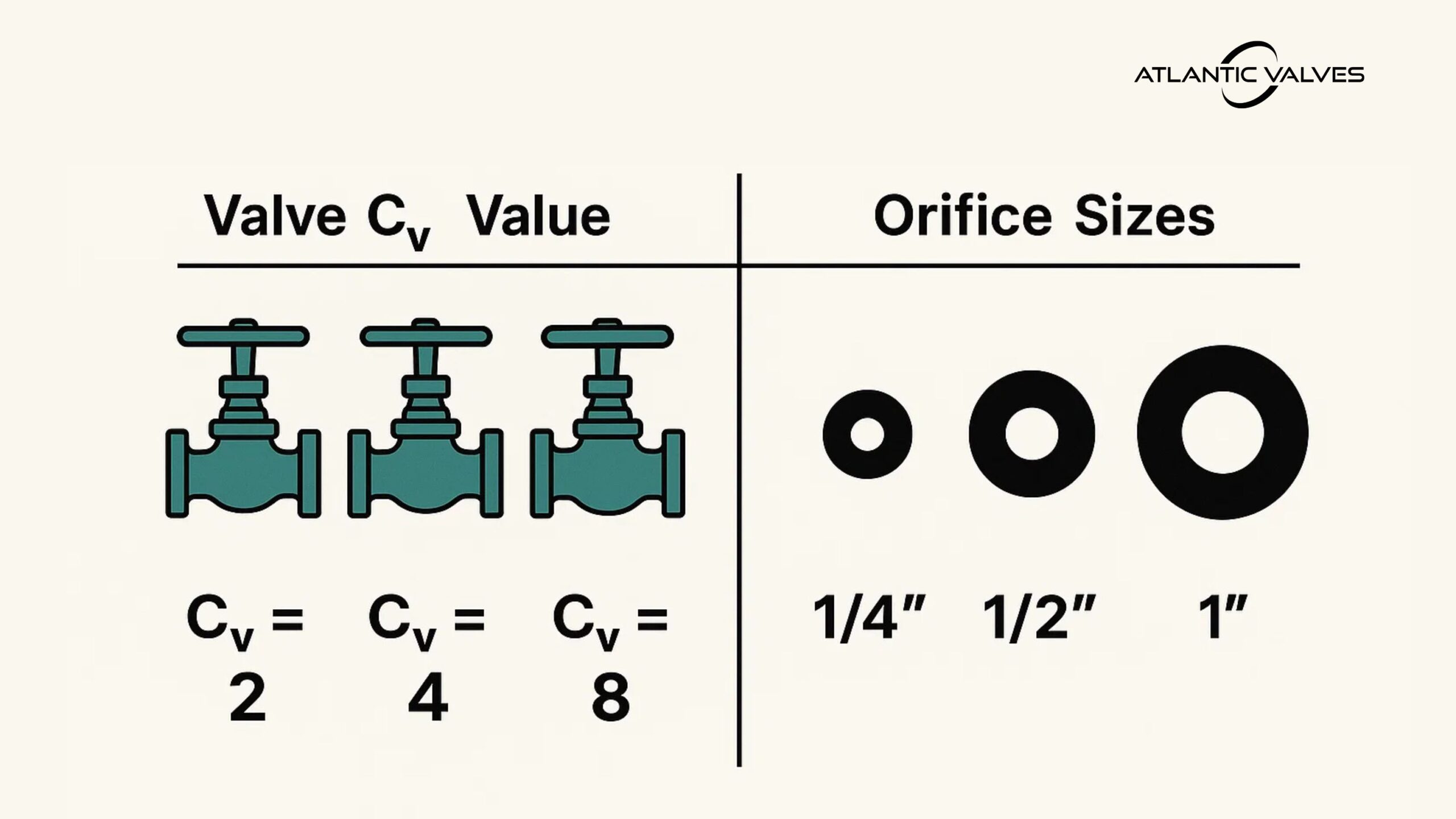
In practice, a bigger orifice generally means more fluid flow. However, Cv values do not increase linearly with orifice sizes and are affected by internal valve geometries. Undersizing valves based on Cv has the following consequences for fluid flow. These effects emanate from the pressure drop across the system and the resulting Cv mismatch.
- Restricted fluid flow through the valve, causing subsequent process interruptions
- Increased pressure drop across the valve, raised energy losses, and increased load on pumps and compressors.
- Increased risk of cavitation and noise.
Oversizing Valves
Oversizing valves based on Cv has the following effects on fluid systems:
- More flow than necessary, which may make it more difficult to precisely control fluid circuits
- Increased energy costs as bigger valves tend to demand more power for actuation
- Increased system sensitivity, which may cause oscillations affecting control systems
Distributors should evaluate flow control requirements and evaluate system operating conditions to ensure they recommend valves with the right Cv values.
Orifice Size
Orifice size is the physical diameter of the valve opening. It is a geometric measurement that specifies the physical size of the valve opening or internal passage. Therefore, orifice size specifies the size of the valve flow area. The orifice size of a valve is expressed in millimeters or inches and is usually included in the valve’s datasheet.
For distributors, you should be able to differentiate valves based on their orifice sizes and properly guide customers who have inadequate knowledge of orifice sizing. This is particularly useful where customers may be confused about the different units of measurement (inches or millimeters).
Larger Orifice Size
A larger orifice size provides a bigger cross-sectional area, allowing more fluid to flow through the valve at any moment. The large orifice size reduces resistance to fluid flow through the valve, thereby:
- Increasing flow rate
- Minimizing pressure drop across the valve
- Increasing flow efficiency
Smaller Orifice Size
A smaller orifice, on the other hand, has a restricted cross-sectional area. It means the valve opening permits less fluid to pass through it under certain flow operating conditions. A smaller valve orifice is useful for fluid applications where:
- Precise fluid control is required. This includes flow metering applications and applications involving throttling.
- High-pressure fluid applications where smaller valve openings yield better flow control accuracy
Undersizing valves based on orifice sizes has the following effects on fluid flow:
- Increased pressure drop across the valve
- Increased energy losses and system inefficiencs
- Slower actuation
As a valve distributor, you should know that valves can have the same orifice sizes but varying flow characteristics. For example, a ball valve and a check valve having the same orifice sizes, say ¼”, will have different performances. The ball valve’s flow path is nearly straight, offering a full flow path. A check valve has part of its valve trim in the path of fluid flow, meaning it is more restrictive than a full-port ball valve. You should highlight such technical differences when specifying valves to Atlantic Valves customers.
Relationship Between Cv and Orifice Size
How do Cv and orifice size relate? Both valve parameters are essential when sizing flow control devices for different applications. For distributors, it is important to communicate their impacts and guide customers accordingly.
Cv value of a valve increases as the orifice size increases. However, this relationship is non-linear. That is, although valves with larger orifice sizes have higher flow rates, their Cv values do not increase at a constant rate.
Two valves can have the same orifice sizes but different Cv values. It is because each valve type has a unique internal construction. Features such as the shape of the valve seat and trim affect the quantity of fluid passing through it under a certain pressure drop.
To demonstrate the relationship between Cv and orifice size, let us consider two solenoid valves, Valve A – ¼” 3-way solenoid valve (231Y-6-110VAC) and Valve B – ¼” stainless steel valve (SS-3J-110VAC) from Atlantic Valves on the customer’s order list. Both valves have an orifice size of 1/4”. The Cv value for Valve A is 0.21, while that of Valve B is 0.4. For a layman, these valves are the same since they have equal orifice sizes. However, Valve B has a smoother and less restrictive flow path than Valve A. In practice, Valve B will permit up to 2 times the flow rate of Valve A for a similar pressure drop.
When to use the Cv Value or Orifice Size to Select Valves
How will you ensure that customers choose the right valves for their applications, and how do they prioritize between Cv values and orifice sizes?
Prioritize Cv value when sizing valves for:
- Flow-sensitive applications
- Dosing fluid applications
- Sizing automated valves for HVAC systems and oil and gas operations.
Cv values come handy when you have specific flow targets and system pressure drops. They’re also essential when comparing different valve designs.
Prioritize orifice sizes when:
- Comparing valves with the same Cv values, e.g., comparing industrial solenoid valves with equal Cv ratings
- Designing low-pressure pneumatic systems
Orifice size is preferable when comparing variants of the same platform and when checking clog tolerance of a valve.
Misconceptions Around Cv Values and Orifice Sizes
Beware of the following misconceptions that customers may have concerning Cv values and orifice sizes. These misconceptions may arise as customers scout for valves for different applications. Watch out for these misconceptions and advise customers accordingly to ensure they get the best valve fits for their projects.
- Large orifice sizes guarantee better flow rates.
A large orifice does not necessarily guarantee flow rates. Internal valve construction and restrictions can lower flow rates even when valve openings are big.
- You can interchange Cv values and orifice size.
Cv value determines the flow performance of a valve. Orifice size defines the geometry and diametral size of the valve opening.
- Orifice size is adequate when sizing valves.
Sizing valves using orifice sizes is risky and inadequate. It is not possible to effectively predict flow characteristics using orifice sizes only. Use Cv to predict precision and valve responsiveness.
Final Words
Always explain the difference between Cv values and orifice sizes of valves to customers seeking Atlantic Valves products. Refer to our technical data and product information sheets to identify the correct product specifications and ensure products fit target applications. Contact our team to become a distributor or request additional products to meet customer demands and requests.